Listen to today's briefing3 min · AI voice by ElevenLabs
Updated · 12 stories · 7 sources · 3 min read
Reflection AI released Beam, a five hundred one billion parameter open-weight model that claims to match Chinese frontier models at lower compute cost, while OpenAI introduced visual ads alongside ChatGPT image generation.
Good morning, it's Tuesday, October sixth, twenty twenty six. Reflection AI has released Beam, its first major open-weight model. Beam has five hundred one billion parameters with twenty three billion active during inference. The Brooklyn-based startup claims Beam matches leading Chinese models on reasoning benchmarks while using three to four times less inference compute. The model was pretrained on twenty three point eight trillion tokens and supports a one million token context window. Reflection plans to release the weights and full technical details this month through hyperscalers and open source libraries. The company has raised roughly four point seven billion dollars and secured more than seven billion dollars in compute deals. OpenAI is adding visual display ads to ChatGPT that will appear alongside images users ask the system to generate. The ads will launch later this month in the US only, clearly labeled and separate from ChatGPT's answers. ChatGPT now has one point two billion weekly users. OpenAI is also expanding measurement tools and brand suitability partnerships with firms including DoubleVerify and Integral Ad Science. Anthropic has moved its Cowork product from running locally to the cloud. The old version ran model inference and a virtual machine on the user's computer, causing battery and performance issues. The new version runs both the model and VM in the cloud, with each session getting its own isolated sandbox. The desktop app now handles file access when the cloud VM needs something from the user's device. An open-source command line tool called RemoveMacAI lets Mac users delete Apple Intelligence models and features. Apple removed the single Settings toggle for disabling Apple Intelligence in macOS twenty seven. The tool deletes the models, which take up twelve to thirty five gigabytes, and turns off all related features. Changes persist across updates and a revert command can restore everything. Ollama version zero point four zero now runs models on Apple's MLX runtime by default on Apple Silicon devices. Decision models including Nimble, tev one, clef and clef-flash are now available on MLX. Additional supported models include gemma four and qwen three point six. A developer tested the Qwen three point eight twenty seven B model on arithmetic problems, asking it to compute sums and return answers in words. With reasoning enabled, the model solved one hundred sixty seven out of one hundred sixty nine problems correctly in one-shot attempts. OpenAI has outlined its approach to text watermarking under EU rules, explaining where watermarks apply and how detection works, with access starting for researchers. And an MIT Technology Review survey of three hundred executives found only thirty four percent of enterprise agentic AI projects reach production, with data fragmentation cited by fifty five percent as the top challenge to expanding agent access to knowledge. That's your generative AI briefing for today.
OpenAI described its approach to text watermarking under EU regulations, explaining where watermarks apply and how detection works, with access beginning for researchers.
OpenAI implementing text watermarking for EU compliance
Watermark detection starts with researcher access first
Article explains where watermarks apply and detection mechanisms
Explain it simply
In plain words OpenAI explained how it will mark AI-generated text to comply with European Union rules. Researchers will get access to the watermark detection system first.
Term to knowwatermarking — embedding hidden signals in AI output to identify its machine origin
What it means for developers: Developers using OpenAI in EU will need to understand watermarking for compliance and transparency
Anthropic shifted Cowork from running model inference and a virtual machine locally to executing both in the cloud, with each session getting its own sandbox.
Old version ran VM locally with high disk, battery and performance cost
New version runs model and VM in cloud, each session isolated
Desktop app handles file access tool calls when VM needs device data
Explain it simply
In plain words Anthropic changed how its Cowork product works. Instead of running the AI model and a virtual machine on your computer, both now run on Anthropic's servers.
Term to knowsandbox — isolated environment where code runs without accessing other sessions or system resources
What it means for developers: Reduces local resource usage and enables mobile access, but shifts compute and control to cloud
MIT Technology Review survey of three hundred executives found thirty four percent of agentic AI projects make it to production, with data fragmentation cited by fifty five percent as top challenge.
Production leaders advance sixty one percent of projects beyond pilot stage
Data fragmentation cited by fifty five percent as top knowledge access challenge
Organizations prioritize RAG, AI evaluation agents and knowledge graphs for investment
Explain it simply
In plain words A survey found that most companies struggle to take AI agent projects from testing to real-world use. Disconnected data systems are the biggest obstacle.
Term to knowagentic knowledge capabilities — ability to give AI agents full contextual understanding of ingested data
What it means for developers: Highlights data infrastructure gaps developers must address to ship agent systems successfully
Over the summer I talked to the CEO of Springboards, a startup building an LLM that’s designed to come up with a wider variety of responses than its mainstream rivals do.
“I guess that makes me a self-loathing AI journalist,” I replied.
The CEO of Springboards and I are far from alone.
On the one hand, public feelings are souring fast.
Reflection AI unveiled Beam, a five hundred one billion parameter model with twenty three billion active parameters, claiming performance matching Chinese models at lower compute cost.
1 million token context window
23.8 trillion tokens
Beam trained on twenty three point eight trillion tokens with one million context
Model uses three to four times less inference compute than rivals
Weights and technical details releasing this month through hyperscalers and neoclouds
Explain it simply
In plain words Reflection AI released its first major model called Beam. It is designed to compete with leading Chinese models but use much less computing power during inference.
Term to knowmixture-of-experts — architecture that activates only some parameters per request, reducing compute cost
What it means for developers: Offers Western open-weight alternative to Chinese models with lower inference costs for enterprise deployment
OpenAI will show visual ads next to ChatGPT-generated images starting later this month in the US only, expanding measurement tools and brand suitability partnerships.
Visual ads appear alongside image generation results for US users only
ChatGPT now has one point two billion weekly users globally
Partners include AppsFlyer, Triple Whale, Adjust, DoubleVerify and Integral Ad Science
Explain it simply
In plain words OpenAI is adding picture ads that will show up when users ask ChatGPT to create images. The ads start in the US this month.
Term to knowbrand suitability — ensuring ads appear in appropriate contexts that align with advertiser values
What it means for developers: May disrupt user experience but creates ad-supported revenue path for free and low-cost tiers
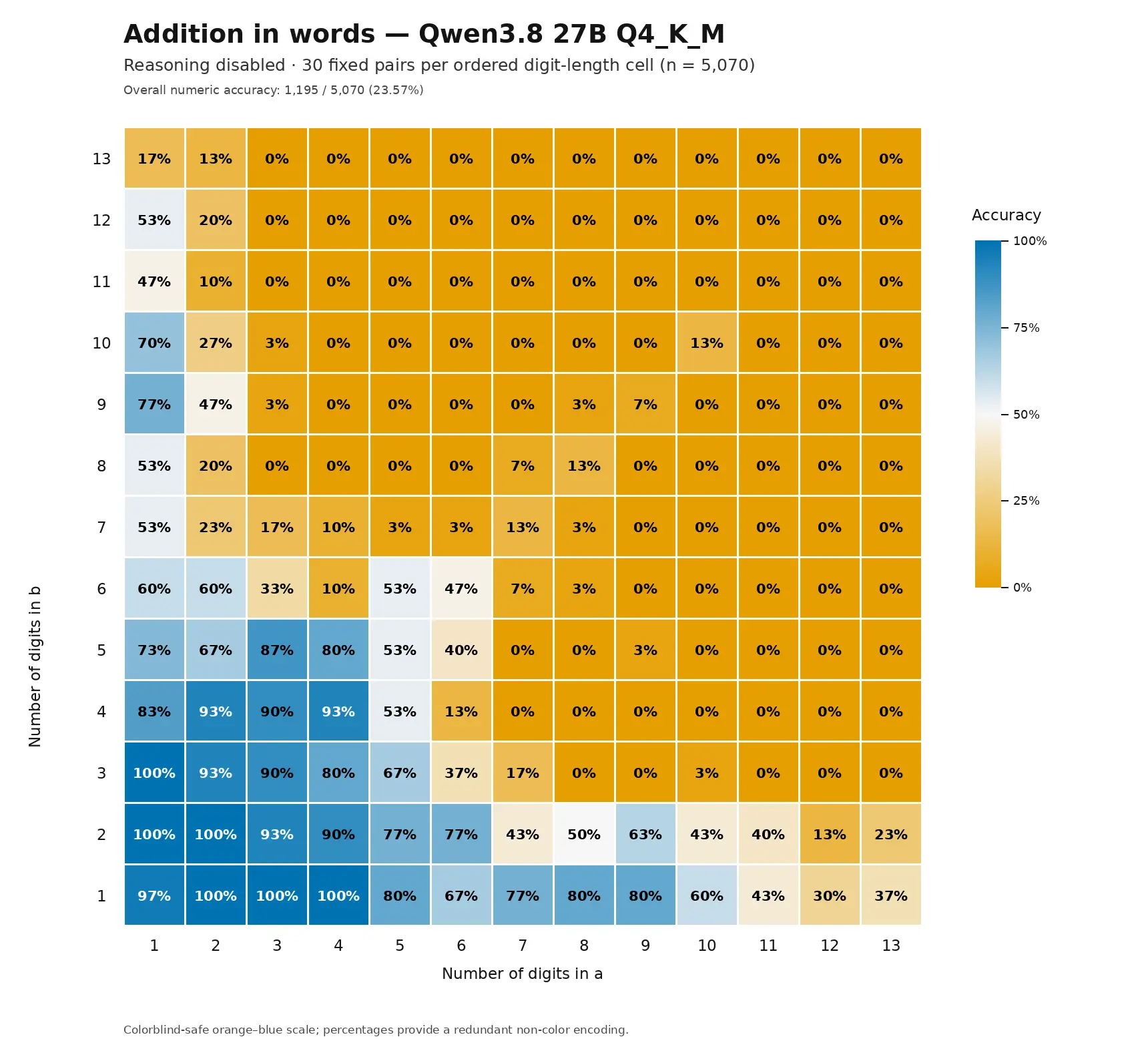
Testing showed Qwen three point eight twenty seven B model got one hundred sixty seven out of one hundred sixty nine addition problems correct when reasoning was enabled.
Qwen3.8
GPT-4
GPT-6
Test had model compute sums and return answers in words
With reasoning disabled, accuracy varied widely across number sizes
With reasoning enabled, one-shot attempts achieved near-perfect accuracy
Explain it simply
In plain words A developer tested how well a Qwen model could add numbers and return answers as words. Turning on reasoning mode greatly improved accuracy.
Term to knowreasoning traces — step-by-step thinking process the model outputs before final answer
What it means for developers: Demonstrates reasoning modes can significantly improve arithmetic accuracy in smaller open models
RemoveMacAI, an open-source command line tool, deletes Apple Intelligence models and disables features after Apple removed the single Settings toggle in macOS twenty seven.
Apple Intelligence models occupy twelve to thirty five gigabytes on Mac
Tool turns off Siri, Writing Tools, Genmoji, Image Playground and summaries
Changes persist across macOS updates with revert command available
Explain it simply
In plain words A new free tool lets Mac users delete Apple's AI features and recover storage space. Apple removed the simple on-off switch in its latest operating system.
Term to knowfoundation models — large pretrained AI models that serve as base for multiple tasks
What it means for developers: Helps developers reclaim significant disk space on Macs where Apple removed built-in removal option
Ollama version zero point four zero automatically runs supported model architectures on the MLX runtime on Apple Silicon devices, with decision models now available.
qwen3.8
gemma4
qwen3.6
qwen3.5
Models run on MLX runtime by default on Apple Silicon
Decision models Nimble, tev one, clef and clef-flash now available
Additional models include gemma four, qwen three point six and qwen three point five
Explain it simply
In plain words Ollama's new version automatically uses Apple's MLX framework to run AI models on Mac computers with Apple chips. Decision-focused models are now supported too.
Term to knowMLX — Apple's machine learning framework optimized for Apple Silicon processors
What it means for developers: Automatic MLX usage should improve performance on Apple Silicon without developer configuration changes
Developer Tools
Last step · 1 minute
Daily quiz
5 questions on today's stories
Browse other days
How we work
Editorial standards
Primary sources first
Lab announcements, release notes and SDK changelogs come before commentary. Every story links to the original.
Only what the source says
Figures, model names and prices are taken from the published text. Where a detail is not stated, we leave it out.
Written for developers
Each story states what changed, by how much, and what it means in practice. No hype, no speculation.
Quick answers
What happened in AI on Tuesday, 6 October 2026?
Reflection AI released Beam, a five hundred one billion parameter open-weight model that claims to match Chinese frontier models at lower compute cost, while OpenAI introduced visual ads alongside ChatGPT image generation. 12 stories from 7 sources are summarised on this page.
What are the top AI stories today?
1. Our approach to EU text provenance rules. 2. Quoting Felix Rieseberg. 3. MCP for agent-to-agent comms may be the riskiest protocol you've never heard of.
Which AI topics does today's briefing cover?
New Models (9), Developer Tools (3).
Where does the information come from?
Headlines and short summaries come from the public feeds of 7 publishers, including Ars Technica, MIT Technology Review, Ollama releases, OpenAI, Simon Willison's Weblog, TechCrunch. Every story links to the original article.
Is there an audio version of this briefing?
Yes. A voice recording covering every story is at the top of this page and is published each day.
Sources
Every headline links to the original. How it works