Today
Top stories

Daily briefing on generative AI

AI news briefing for Friday, 13 November 2026

Listen to today's briefing3 min · AI voice by ElevenLabs

Updated · 12 stories · 11 sources · 3 min read

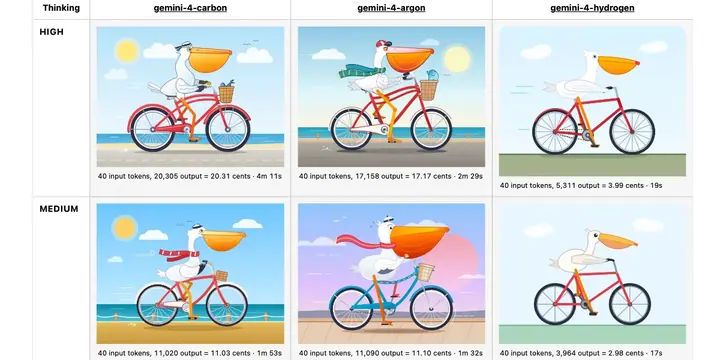
Google released Gemini 4 Hydrogen at $1.50 per million input tokens, delivering triple the coding performance of Gemini 3.8 Flash and ranking fifth on Agent Arena for agentic tasks.

Step 1 · 30 seconds

Summary

Step 2 · 3 min

Listen

Voiced by ElevenLabs from today's briefing.

Read the transcript

Good morning. This is dailybrief, and here are today's top stories in generative AI, for Friday, November 13. Google DeepMind has released Gemini 4 Hydrogen, pricing the model at one dollar fifty per million input tokens and seven dollars fifty per million output tokens. According to Google, Hydrogen delivers a one million token context window and scores fifty-seven percent on Terminal-Bench 4.1, more than triple the eighteen point two percent scored by Gemini 3.8 Flash. The model ranks fifth on Agent Arena for agentic tasks and first overall on Vals Tax Agent Bench at fifty-two point three percent. Google said Hydrogen finishes tasks two point five times faster than Gemini 3.8 Flash at its high default setting while cutting fabricated claims by more than five times. In other news, Google introduced Orchestrator in its Antigravity platform to switch between models dynamically within a single session. According to Google, Orchestrator reached near-Carbon task success rates on Terminal-Bench 4.0 while consuming twenty-four percent less quota and completing nineteen percent faster. The system allows Carbon to act as coordinator while Hydrogen powers worker and verifier agents across parallel workspaces. Meanwhile, according to Simon Willison, Google will double the prices of Gemini 4 Carbon and Argon on December 1st. Willison noted that Hydrogen currently offers only a twenty-five percent discount compared to those models but will represent a seventy-five percent savings after the price increase. He also pointed out that Hydrogen is fifteen times more expensive than Claude Haiku 5.5 and GPT-6 Luna, which both cost ten cents per million input tokens. Turning to developer tools, OpenAI released Python SDK version 3.50.0 on November 12th. According to the release notes, the update exposes reasoning input transformations on API responses, giving developers new visibility into how inputs are processed. Also today, IBM released Granite 4.1 3B and 8B LLMON preview models on Hugging Face. According to IBM, the models use a markup language called LLMON that separates instructions from data using reserved special tokens instead of JSON characters. IBM said attack success rates for indirect prompt injections drop to nearly zero on some benchmarks while the models maintain general capability relative to standard Granite 4.1 Instruct models. Google deployed Gemini 4 Hydrogen to Google Search globally today. According to the Google AI Blog, all users worldwide can now receive structured responses with comparison tables, images and custom tools. Google said Hydrogen's advanced reasoning powers an improved query fan-out technique that connects users to a broader range of helpful links. And finally, Jensen Huang resigned as Nvidia CEO effective immediately on Thursday. According to WIRED, the resignation followed a board investigation into an affair Huang had with someone alleged to be an asset of China's Ministry of State Security. Nvidia's chief financial officer, Colette Kress, will serve as interim CEO. The board said it will consider both internal and external candidates for a permanent replacement. That's dailybrief for today. Every story is linked to its original source on our website.

Podcast Two-host conversation with Jessica & Eric · 5 min

Read the podcast transcript

Jessica: Okay, so Jensen Huang is out at Nvidia.

Eric: Wait, what?

Jessica: Resigned effective immediately yesterday. Board investigation into an affair with someone WIRED is calling an alleged Chinese intelligence asset.

Eric: That's... wow. Colette Kress is interim CEO?

Jessica: Yep, the CFO steps in. This is dailybrief, I'm Jessica—

Eric: and I'm Eric, it's Friday, November thirteenth, twenty twenty-six.

Jessica: Honestly, the timing here is wild because everyone is completely dependent on Nvidia right now for GPU supply.

Eric: Right, and we have no idea what this does to roadmap commitments or pricing or anything.

Jessica: Exactly. Huge uncertainty at the worst possible moment.

Eric: Speaking of timing, Google dropped Gemini 4 Hydrogen yesterday.

Jessica: They did! One dollar fifty per million input tokens, seven fifty output. One million token context window.

Eric: And it's ranking fifth on Agent Arena, first on that Vals Tax Agent Bench.

Jessica: The jump on Terminal-Bench is what got me—fifty seven percent versus eighteen point two for Gemini three point eight Flash. That's three times better.

Eric: Okay, but how does a dollar fifty compare to everything else right now?

Jessica: So according to Simon Willison, it's currently twenty five percent cheaper than Carbon and Argon, but—

Eric: But those two are doubling in price December first.

Jessica: Exactly. So after December first, Hydrogen becomes a seventy five percent discount compared to the premium models.

Eric: That feels like they're pricing people into the cheaper tier.

Jessica: Oh, totally. Though Simon also noted Hydrogen is still fifteen times more expensive than Claude Haiku or GPT-6 Luna.

Eric: Right, so it's cheap for Google, not cheap cheap.

Jessica: But they also launched this Orchestrator thing, which is kind of clever.

Eric: The automatic model switching?

Jessica: Yeah, it picks between Carbon and Hydrogen mid-session depending on the task. Google says it's twenty four percent less quota usage and nineteen percent faster on Terminal-Bench four point zero.

Eric: Hmm. So Carbon coordinates and Hydrogen does the grunt work?

Jessica: Exactly. Carbon runs the orchestrator and verifier agents, Hydrogen powers the workers.

Eric: I mean, that makes sense if you trust the switching logic. But you're giving up control.

Jessica: True, though if it actually saves you a quarter of your token budget...

Eric: Yeah, fair.

Jessica: And Hydrogen is now powering Google Search globally as of yesterday.

Eric: For everyone?

Jessica: Yep. According to the Google AI Blog, it handles multi-part questions with that improved query fan-out technique, gives you tables, images, links to websites.

Eric: So this is the reference implementation now—like, Hydrogen at Google scale in production.

Jessica: Exactly. If it's good enough for Search, it's probably good enough for your app.

Eric: Okay, different topic. IBM released these Granite four point one models that are supposed to be resistant to prompt injection.

Jessica: Yes! The three B and eight B LLMON models. They're trained on this new markup language that uses special tokens for structure instead of JSON characters.

Eric: And the attack success rate drops to nearly zero on some benchmarks?

Jessica: On some benchmarks, yeah. The idea is you explicitly separate instructions from data, so hidden attacks in user input just get ignored.

Eric: That's... honestly that's huge if it actually works in production.

Jessica: I know, right? Especially if you're handling any untrusted data. These are preview models, but it's a really smart approach.

Eric: OpenAI also shipped Python SDK three point fifty point zero this week.

Jessica: On November twelfth, yeah. It exposes reasoning input transformations on API responses.

Eric: So you can see how the model is preprocessing your prompts before it reasons?

Jessica: Exactly. It's a visibility thing—better for prompt engineering and debugging.

Eric: Okay, that's useful.

Jessica: Quick hits—Google also launched Gemini smartglasses starting at three hundred ninety five dollars. It's a collab with Samsung, Gentle Monster, and Warby Parker, and they're pushing the privacy angle hard.

Eric: Privacy angle on always-on AI glasses. Sure.

Jessica: And there's a pretty rough story out of Ars Technica about families calling for AI moratoriums in schools after a Gemini pilot. A lawsuit is apparently calling Gemini a quote 'suicide coach.'

Eric: Yeah, I saw that. That's really serious.

Jessica: It is. We'll keep an eye on how that develops.

Eric: Alright, that's it for today. Every story is linked to its source on the dailybrief website.

Jessica: Have a good weekend, everyone.

Step 3 · 2 minutes

Top 3 stories

Google DeepMind

Google releases Gemini 4 Hydrogen at $1.50 per million input tokens

New Models

Google DeepMind launched Gemini 4 Hydrogen with a one million token context window, scoring 57% on Terminal-Bench 4.1 and ranking fifth on Agent Arena.

  • $1.50 per million input tokens
  • $7.50 per million output tokens
  • 1 million-token context window
  • Gemini 4
  • Priced at $1.50 input and $7.50 output per million tokens
  • Scores 57% on Terminal-Bench 4.1 versus 18.2% for Gemini 3.8 Flash
  • Ranks fifth on Agent Arena and first on Vals Tax Agent Bench

Explain it simply

In plain words Google released a new AI model called Hydrogen for everyday coding tasks. It costs $1.50 per million input tokens and is three times better at coding than the previous Flash model.

Term to know agentic workflows — Tasks where AI models autonomously plan and execute multi-step actions with tools

What it means for developers: Offers faster, cheaper execution for coding tasks while pairing with premium models for complex architecture decisions

Read the full story at Google DeepMind

Google's Orchestrator automatically switches between Carbon and Hydrogen models within sessions, achieving 24% less quota usage and 19% faster completion on Terminal-Bench 4.0.

  • Orchestrator switches between models like Carbon and Hydrogen automatically
  • Consumes 24% less quota and completes 19% faster on Terminal-Bench
  • Carbon coordinates while Hydrogen powers worker and verifier agents

Explain it simply

In plain words Google's new Orchestrator feature automatically picks the right AI model for each part of a task. This uses fewer tokens and finishes work faster than using one model throughout.

Term to know multi-model workflows — Using different AI models for different subtasks within a single development session

What it means for developers: Reduces token costs and speeds up complex projects by matching task difficulty to model capability automatically

Read the full story at OpenAI
OpenAI Python SDK releases

Gemini 4 Carbon and Argon prices set to double on December 1

Developer Tools

According to Simon Willison, Carbon and Argon will double in price on December 1, making Hydrogen a 75% discount compared to its current 25% savings.

  • Carbon and Argon prices double on December 1, 2026
  • Hydrogen currently 25% cheaper, will become 75% discount after increase
  • Hydrogen is 15 times more expensive than Claude Haiku and GPT-6 Luna

Explain it simply

In plain words Google will double the prices of its two top Gemini 4 models on December 1. After that increase, Hydrogen will cost 75% less than those premium models.

Term to know effort levels — Settings that control how much computation a model uses per query

What it means for developers: Developers should plan token budgets now; Hydrogen becomes much cheaper relative to Carbon and Argon after December 1

Read the full story at OpenAI Python SDK releases

Today's newsmakers

Who's making AI news

The companies that feature most in today's stories, ranked by how often and how prominently they appear.

  1. #1

    Google

    8 stories today

    New today

    +5 more stories

  2. #2

    OpenAI

    5 stories today

    New today

    +4 more stories

  3. #3

    IBM

    2 stories today

    New today

    +1 more story

  4. #4

    Nvidia

    2 stories today

    ▼ 3

    +1 more story

  5. #5

    Hugging Face

    1 story today

    New today
Also in the news

Company names and logos are trademarks of their owners, shown only to identify them.

Optional · if you have more time

More stories

9 more stories

OpenAI

OpenAI Python SDK 3.50.0 exposes reasoning input transformations

OpenAI released Python SDK version 3.50.0 on November 12, exposing reasoning input transformations on responses as a new feature.

  • Version 3.50.0 released on November 12, 2026
  • Exposes reasoning input transformations on API responses
  • Also includes dependency updates and documentation changes

Explain it simply

In plain words OpenAI updated its Python software development kit to let developers see how inputs are transformed during reasoning. This gives more visibility into how the model processes requests.

Term to know reasoning input transformations — Changes applied to user inputs before reasoning models process them

What it means for developers: Gives developers visibility into how reasoning models preprocess inputs, enabling better prompt engineering and debugging

New Models
OpenAI

IBM releases Granite 4.1 LLMON models resistant to prompt injection

IBM released Granite 4.1 3B and 8B models trained on LLMON markup language, reducing prompt injection attack success rates to nearly zero on some benchmarks.

  • Granite 4.1 3B and 8B LLMON preview models now available
  • Attack success rates drop to nearly zero on some benchmarks
  • Uses special tokens for structure instead of JSON characters

Explain it simply

In plain words IBM released experimental models that use a new markup language called LLMON. This language separates instructions from data, making the models much harder to trick with hidden attacks.

Term to know prompt injection — Attacks where malicious instructions hidden in data hijack model behavior

What it means for developers: Offers stronger security against injection attacks while maintaining general capabilities, especially useful for production applications handling untrusted data

New Models
Simon Willison's Weblog

Google Search globally launches with Gemini 4 Hydrogen

Google deployed Gemini 4 Hydrogen to Google Search worldwide, according to the Google AI Blog, providing structured responses with tables and images.

  • gemini 0.37
  • Gemini 4
  • GPT-6
  • Hydrogen now powers Google Search globally for all users
  • Handles multi-part questions with improved query fan-out technique
  • Delivers visual responses with tables, images and custom tools

Explain it simply

In plain words Google upgraded its search engine with the new Hydrogen AI model. All users worldwide can now ask complex questions and get answers with tables, images and links to relevant websites.

Term to know query fan-out — Technique where one question triggers multiple simultaneous searches across related subtopics

What it means for developers: Hydrogen becomes the reference implementation for consumer-facing AI features at Google scale, demonstrating production readiness

New Models
Ars Technica

Jensen Huang resigns as Nvidia CEO effective immediately

Jensen Huang resigned as Nvidia CEO on Thursday following a board investigation into an affair with an alleged Chinese intelligence asset, according to WIRED.

  • Gemini 4
  • Resigned effective immediately on Thursday, November 13, 2026
  • CFO Colette Kress serving as interim CEO
  • Investigation followed reports of relationship with alleged intelligence asset

Explain it simply

In plain words Nvidia's longtime CEO Jensen Huang stepped down immediately after the board investigated his relationship with someone reportedly connected to Chinese intelligence. The chief financial officer will run the company temporarily.

Term to know export controls — Government restrictions on selling advanced technology to certain countries

What it means for developers: Leadership change at the dominant AI chip maker creates uncertainty for GPU supply, pricing and roadmap commitments

New Models
Hugging Face

LLMON: An LLM-Native Markup Language, now in Granite 4.1 3B and 8B

LLMs rely on their context to generate the next set of tokens.

  • To address this, we developed LLMON (LLM Object Notation, pronounced “lemon”), an LLM-native markup language for explicitly communicating structure…
  • Today we are releasing two experimental preview models, derived from Granite 4.1 base models, trained to consume and generate LLMON-marked text…
  • Indirect prompt injections, hidden in user data, are mostly ignored by LLMON models due to explicit instruction/data separation.
New Models
Google AI Blog

Google Search gets a major upgrade with Gemini 4 Hydrogen

We are bringing Gemini 4 Hydrogen to Google Search globally to provide you with more intuitive, visual, and precise answers.

  • Gemini 4
  • We are introducing Gemini 4 Hydrogen to provide more helpful and intuitive responses in Google Search.
  • You can now ask complex, multi-part questions because our model understands your intent with greater precision.
  • Our improved reasoning capabilities connect you to a wider range of relevant websites and helpful links.
New Models
WIRED

Jensen Huang Resigns as Nvidia CEO

Jensen Huang stepped down as the chief executive of Nvidia on Thursday, four days after the company announced its internal investigation into an affair he had with Alice Huang, also known as Huang Le, an alleged asset of China’s…

  • “Jensen Huang has resigned as President, Chief Executive Officer, and a member of the Board, effective immediately,” the Nvidia board said in a…
  • The board’s investigation was announced on November 8, slightly less than two weeks after The New York Times reported that the chief executive had…
  • The alleged relationship with a subordinate, along with Huang’s business dealings with Megaspeed, a Singapore-based AI company where Alice Huang…
Also covered byTechCrunchThe Verge
Chips & Infrastructure

Last step · 1 minute

Daily quiz

5 questions on today's stories

Browse other days

How we work

Editorial standards

Primary sources first

Lab announcements, release notes and SDK changelogs come before commentary. Every story links to the original.

Only what the source says

Figures, model names and prices are taken from the published text. Where a detail is not stated, we leave it out.

Written for developers

Each story states what changed, by how much, and what it means in practice. No hype, no speculation.

Quick answers

What happened in AI on Friday, 13 November 2026?

Google released Gemini 4 Hydrogen at $1.50 per million input tokens, delivering triple the coding performance of Gemini 3.8 Flash and ranking fifth on Agent Arena for agentic tasks. 12 stories from 11 sources are summarised on this page.

What are the top AI stories today?

1. Google releases Gemini 4 Hydrogen at $1.50 per million input tokens. 2. Google introduces Orchestrator to switch models dynamically in Antigravity. 3. Gemini 4 Carbon and Argon prices set to double on December 1.

Which AI topics does today's briefing cover?

New Models (10), Developer Tools (1), Chips & Infrastructure (1).

Why does “Google releases Gemini 4 Hydrogen at $1.50 per million input tokens” matter?

Offers faster, cheaper execution for coding tasks while pairing with premium models for complex architecture decisions. Google released a new AI model called Hydrogen for everyday coding tasks. It costs $1.50 per million input tokens and is three times better at coding than the previous Flash model.

Why does “Google introduces Orchestrator to switch models dynamically in Antigravity” matter?

Reduces token costs and speeds up complex projects by matching task difficulty to model capability automatically. Google's new Orchestrator feature automatically picks the right AI model for each part of a task. This uses fewer tokens and finishes work faster than using one model throughout.

What is agentic workflows?

Tasks where AI models autonomously plan and execute multi-step actions with tools.

What is multi-model workflows?

Using different AI models for different subtasks within a single development session.

Sources

Every headline links to the original. How it works